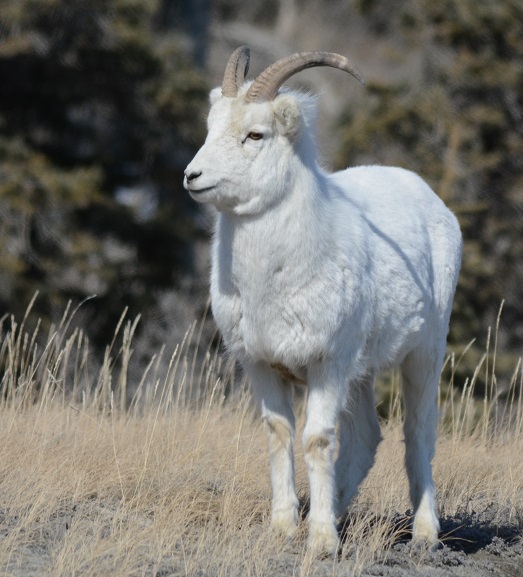
Search for Dall Sheep in Beautiful and Rugged Kluane National Park
I went to Kluane National Park in the extreme southwest corner of the Yukon to search for Dall Sheep. The area is beautiful beyond words. The rugged, snow-covered mountains are a sight to behold. I have seen the park in both summer and winter and although it is always lovely, it is especially beautiful in winter. Few tourists see the park at this time of year. There are no roads and no tourist facilities.
Kluane National Park is 22,013 sq km (8,499 sq miles) and contains Canada’s highest peak, Mount Logan. Picnic sites, hiking trails, and campgrounds are along the park’s edge, but there are no roads to the interior. Two visitor centres, where you can plan trips into the park, are open only during the summer months.
Dall Sheep
I went to a mountain on the edge of the park where the Alaska Highway travels along the park border for a while. Dall Sheep are known to be in this area. I didn’t see any, so I parked in a rest area and scanned the mountains with my binoculars. It did not take me long to locate a small group of them, but they were much too far up the mountain to get a photo. So I waited. I stopped in Haines Junction and bought some food, so I made some lunch, ate an apple, drank juice, and watched the mountain. By noon, I had located two more groups, but, like the first group, they were too far away to photograph. I waited.
People often ask me what the most crucial trick to wildlife photography is. The answer is lots of patience—more waiting.
After several hours, a large group of Dall Sheep emerged from the woods near the bottom of the mountain, and I rushed over to photograph them.
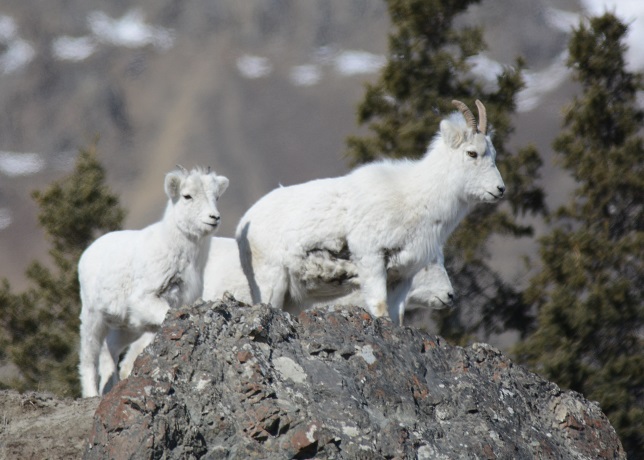
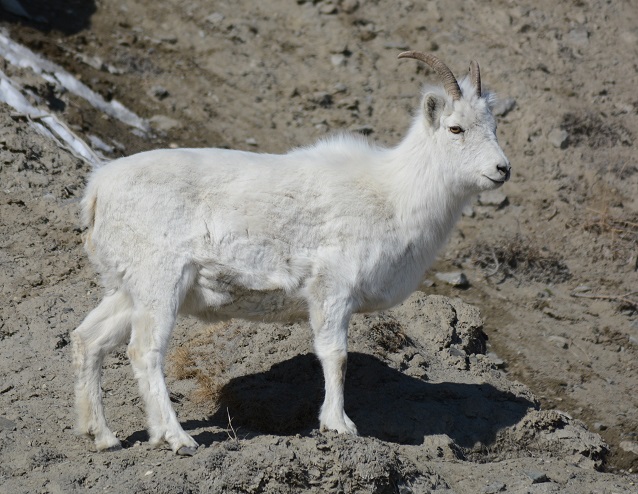
There are two species of native mountain sheep in North America: the Dall Sheep and the Rocky Mountain Bighorn Sheep (there are also some sub-species). They are similar in most ways. The Bighorn Sheep are brown and live in the western U.S.A. and along Canada’s British Columbia/Alberta border. The Dall Sheep are white and live only in Alaska, Yukon and northern British Columbia.
I have seen the Bighorn Sheep countless times, but this was the first time I had seen the Dall Sheep. Well, actually, the second. When I was in Denali National Park in Alaska, the tour guide pointed out some Dall Sheep to the tourists on the bus. I saw several tiny white dots near the top of a mountain. Not sure if they were sheep or snowflakes, so I didn’t count that, although I am sure the guide was correct. The sheep spend the summers high up in the mountain tops, so unless you have super-vision or are a mountain climber, you will probably not see them unless you come north during the winter when the sheep live at lower elevations.
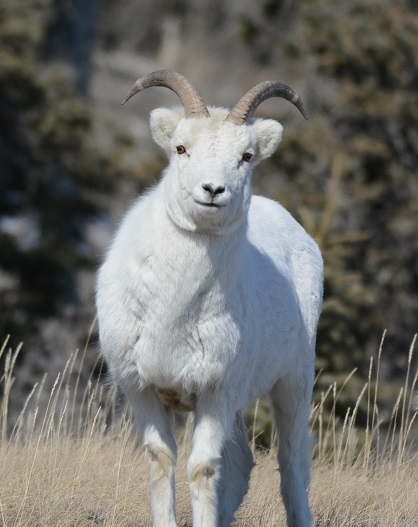
Except during breeding season, the sheep separate into two societies; one consists of ewes and lambs and the other of adult males, called rams. The group that I saw was one of the former. I did not see any adult males, which is unfortunate because, with their large horns, they are very impressive. The horns are wide at the base and grow in a curl around the ear. The Bighorn Sheep, including the horns, are slightly larger than the Dall Sheep. The horns of the Bighorn Sheep are more curled, while the Dall Sheep’s horns are wider, but both are awesome.
Stone Sheep
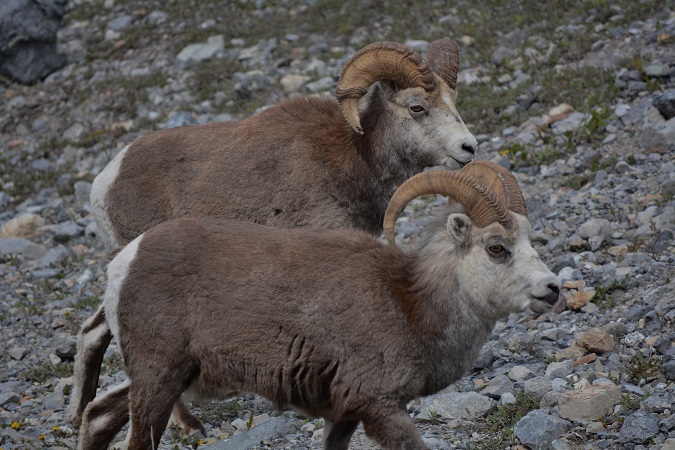
There are a few sub-species of Dall Sheep. Stone Sheep are one. They look like Dall Sheep except that they are the brown sheep of the family and can easily be mistaken for Bighorn Sheep. The horns and range differ from the Bighorns, and they have grey faces. They are simply brown Dall Sheep.
Bighorn Sheep
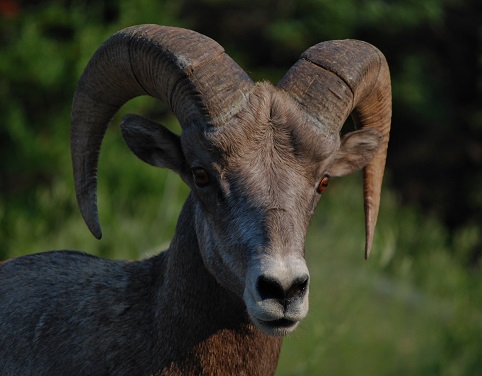
Bighorn Sheep are brown except for the nose and rump, and their horns have a tighter curl. I photographed Stone Sheep on a previous trip to Alaska. They can be observed along the Alaska Highway at Summit Lake, Stone Mountain Provincial Park, and Muncho Lake Provincial Park.
Horns or Antlers
What is the difference between horns and antlers? Antlers fall off each year, and the animal grows a new set in time for the annual breeding season. Horns do not fall off and continue to grow year after year.
Where to see Dall Sheep
The best places to observe Dall Sheep are:
1. Muncho Lake along the Alaska Highway in northern British Columbia,
2. Along the Seward Highway south of Anchorage, Alaska,
3. Sheep Mountain in Kluane National Park, and
4. Near Faro, Yukon.
Beautiful Kluane National Park
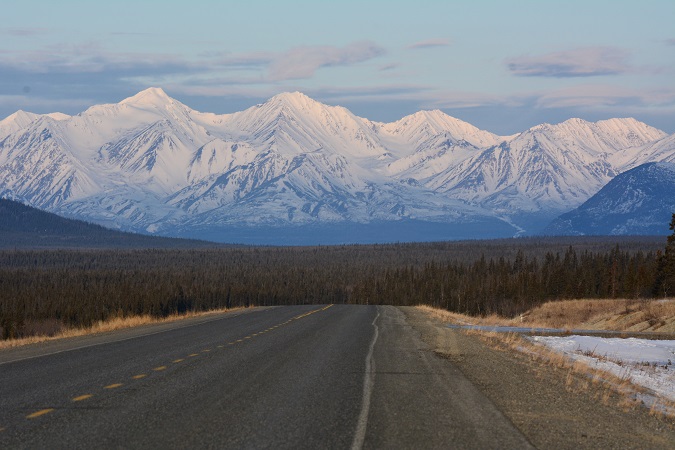
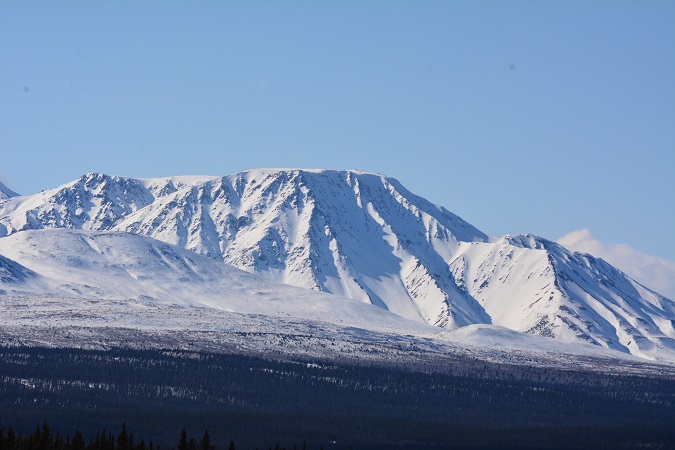
I got some photos, and it was a successful day after all. Had I not seen the sheep, it still would have been a lovely day. The sun was shining, and the scenery was stunning. The Yukon in winter is not on many people’s bucket list, but it should be.