The Klondike Gold Rush
The history of the Klondike Gold Rush and how to reenact it. Updated June 2022.
Gold was discovered in the Klondike region of the Yukon, in Canada, in 1896. In 1897, word of the strike reached the outside world, and tens of thousands of people rushed to the Klondike to get rich. In 2014, I researched the Klondike Gold Rush and followed the route (although not exactly) that the stampeders took.
Three out of four people that went to the Klondike in 1897 were Americans. There were also many Europeans. Canadians were in the minority.
Getting to the Klondike was very difficult. About 100,000 people started on the stampede, but only about 40,000 made it to the Klondike. The other 60% either gave up and turned back or died in the attempt. Many people froze to death. Many died of scurvy, pneumonia, accidents and other ailments. Most of the thousands of horses people brought north died before reaching the Klondike.
Start at Skagway Alaska
The starting point for most of the stampeders was a boat ride from Seattle, Washington, to Skagway, Alaska. You can read my story about Skagway here:
https://mythatchedhut.com/skagway-alaska/
The Chilkoot Trail
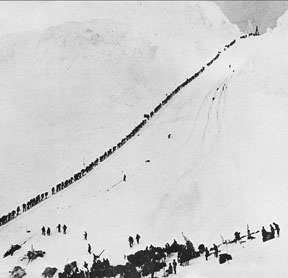
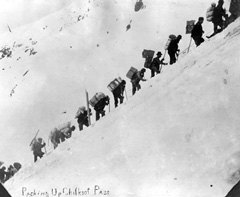
Crossing the Chilcoot Trail in 1897
From Skagway, the stampeders travelled over what is known as the Chilkoot Trail. This involved hiking over the White Pass with a ton of supplies. The North West Mounted Police were waiting at the top of the pass and would not let anyone into the Yukon without a ton of food and other supplies. To do so was to invite death from starvation or scurvy.
It is a distance of 53 km (33 miles) from Skagway, Alaska, to the town of Bennett in Canada on the other side of the White Pass. Carrying a ton of supplies meant walking a few km with as much as one could carry and then going back for another load. For every five km, a person might walk back and forth more than 40 times. This meant that to travel 53 km with a ton of goods; one might walk more than 2,000 km. People who had enough money could hire the local natives to carry their goods over the pass. They charged one dollar per pound.
A railroad was built over the pass and was completed in 1900. The White Pass and Yukon Route Railroad is one of the most scenic railway trips in the world.
Reenact the Klondike Gold Rush – Part One: The Chilkoot Trail over the White Pass
Once the railway was completed, the Chilkoot Trail was abandoned. It rested in silence for decades. Then in the 1970s, people began to take an interest in the history of the Klondike Gold Rush, and many wanted to reenact the trip. Today the trail is called the Klondike Gold Rush International Historic Park and is a national historic site in both Canada and USA. The only place I know of that is a historic site in two countries. However, it is still more commonly known as the Chilkoot Trail.
Many people hike it every year. But they do it in summer, not in winter as the stampeders did. Also, they need only enough supplies for the four-day trip and not a ton of supplies to last a year. You still have the option of going by train. Now there is also a road over the White Pass. Previously, I went by train. This time I decided to cross the mountains by road in mid-February. I stopped at the top of the pass for a while to enjoy the spectacular alpine winter scenery. Few tourists come here during winter. My story of the White Pass can be found here:
https://mythatchedhut.com/white-pass/
Why Did They go in Winter? Why Did I go in Winter?
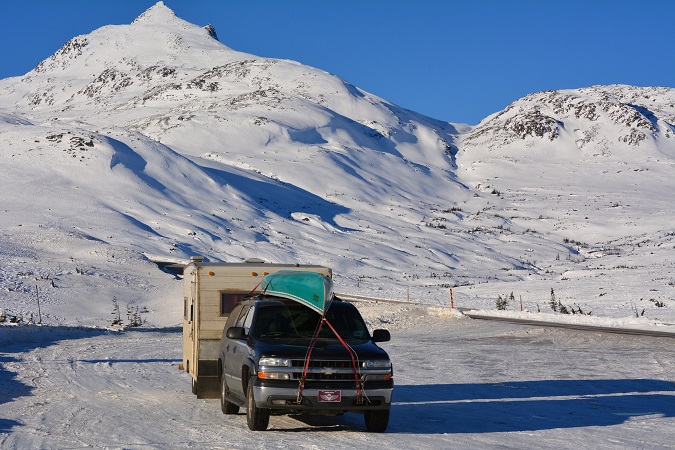
The stampeders crossed the White Pass during winter for a reason. On the other side of the mountains, they stopped at the town of Bennett on the shore of Lake Bennett. They had to cut down trees, saw the logs into lumber, and build a raft or boat to get across the lake. They wanted to depart in the spring; therefore, they had to cross the Chilcoot Trail during winter to enable them to build a raft and be ready to leave when the ice melted. The town of Bennett grew to a population of 30,000 people. As soon as the ice broke up and the lake was navigable, a flotilla of about 7,000 rafts set out from Bennett to the Klondike.
Why am I carrying a canoe over the White Pass in the middle of winter? This is just one leg of a journey from Guatemala to the Arctic coast. I plan to go canoeing in the Arctic Ocean in the summer. (other parts of this journey can be found on this website).
Reenact the Klondike Gold Rush – Part Two: Visit the historic town of Bennett

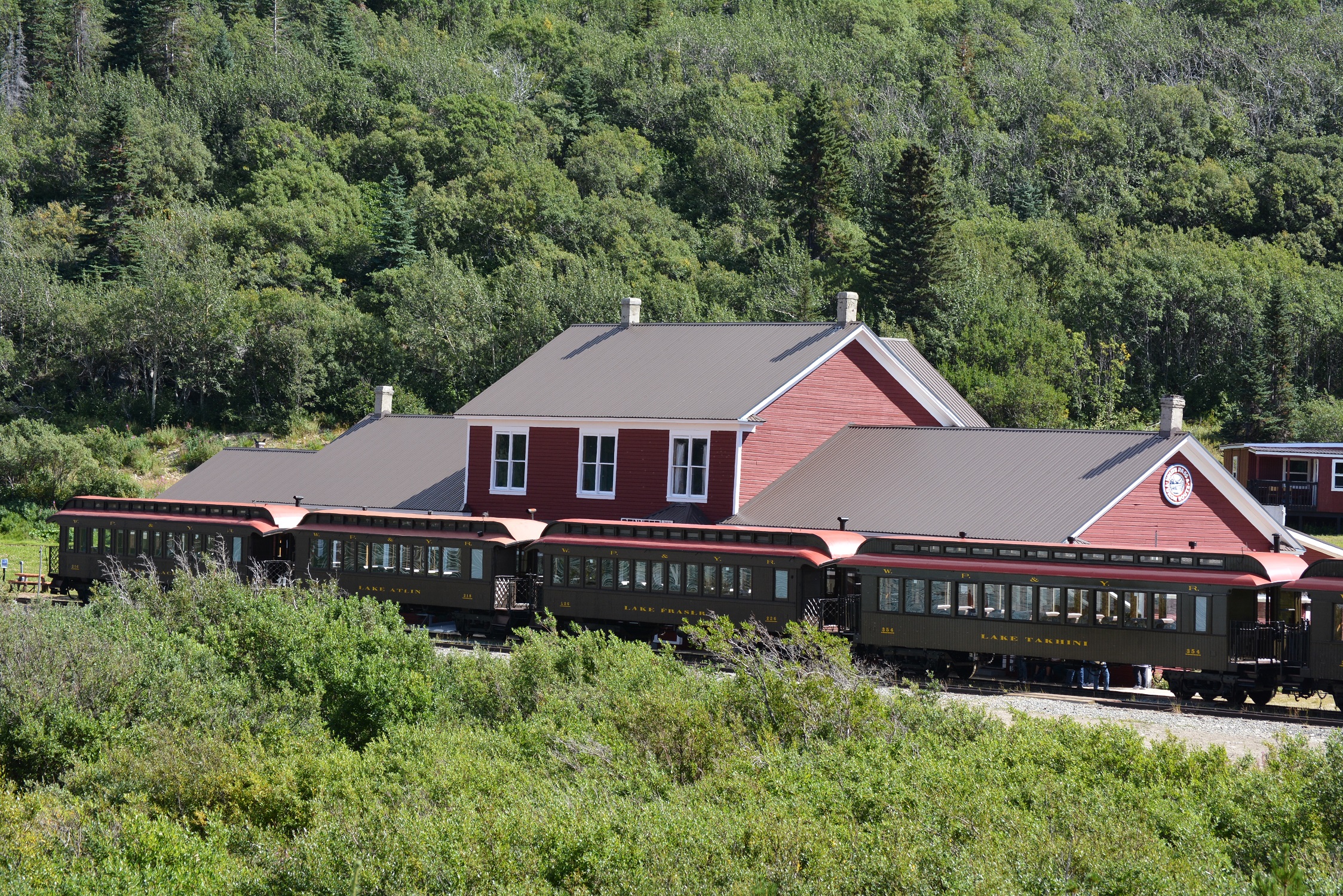
All that is left of Bennett today is the church and one house, and the train station. There is a primitive campground with no facilities. The only way to get to Bennett today is the same as in 1897; you can walk over the Chilkoot Trail or, after 1900, by train. There are no roads.
I took the train to Bennett. The scenery alone is worth the trip. The train cars are still the original ones made in the 1800s and heated by pot-belly stoves in each car, although the train now only travels during the summer months, and heat is not needed. The locomotives were made in the 1950s, but the railway still has a couple of old steam engines that they use on special occasions. The train trip includes time to walk around the town of Bennett, although today it is more like a forest than a town. I highly recommend this excellent day trip, or you can camp there overnight.
Here is my story about the White Pass & Yukon Railroad:
https://mythatchedhut.com/white-pass-yukon-route-railroad/
From Bennett, the stampeders travelled across Lake Bennett and through lakes and rivers to the current site of the city of Whitehorse. Those with money could abandon their crude raft and travel on a paddle-wheel steamboat for the remainder of the trip. However, the majority of the people carried on down the river.
Reenact the Klondike Gold Rush – Part Three: Travel from Bennett to Whitehorse by water
To reenact the trip from Bennett to Whitehorse, after hiking the Chilkoot Trail, bring a canoe or kayak up to Bennett on the train. (Have a friend meet you there with the canoe.) You can then travel by lake and river to Whitehorse. Or canoe from Bennett to Carcross at the other end of Lake Bennett. That would be enough to reenact the trip. Have a friend meet you there to pick up the canoe and take you to Whitehorse. Another option would be to have someone in Carcross pick you up in a boat.
Before attempting to hike the Chilkoot Trail or travel from Bennett to Whitehorse by water, ensure that you have the skills, equipment and strength to make the trip. Wilderness areas can be hazardous. My Thatched Hut is in no way responsible for your safety if you make this trip.
You could skip the water portion of the trip and proceed to Carcross on the train.
Reenact the Klondike Gold Rush – Part Four: Ride a Paddle-wheel Steamboat at Whitehorse
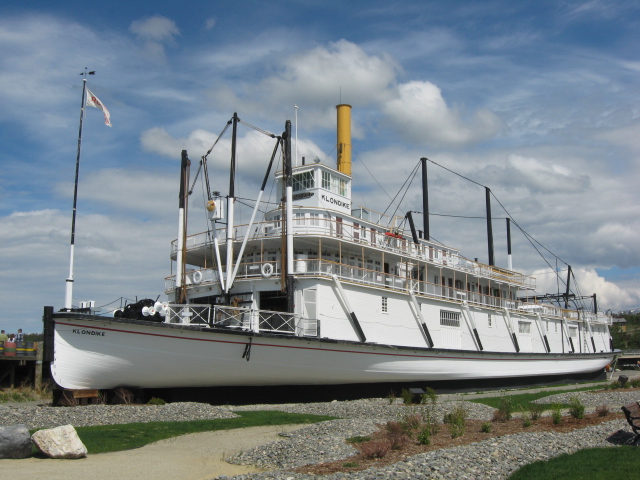
The SS Klondike is one of the river boats that took people and cargo from Whitehorse to Dawson City and back. It is now located on the shore at Whitehorse. A second-class ticket cost $25, the average monthly wage for a man in those days. Imagine paying a whole month’s salary for a ride to the next town. The trip took 36 hours. For $10 more, a person could go first class. Second-class passengers were confined to the cargo area while first-class passengers dined in luxury on the floor above.
On the return trip, the cargo area was usually full of sacks of ore that were thought might contain gold. The ship is a stern-wheeler, which means a steam paddle powers it at the rear of the ship. Some ships had the paddle mounted on the side. It is worth your time to stop and tour the ship. You will learn about life on the Yukon River during the Klondike Gold Rush.
After touring the paddle-wheel steamboat to simulate the ride to Dawson, you can drive there. It is about 500 km north of Whitehorse.
Reenact the Klondike Gold Rush – Part Five: Tour the City of Dawson and search for gold.
Almost 40,000 people made it to the Klondike, where they created the city of Dawson and began their search for gold. The gold was discovered in 1896, and there were already a few thousand people in the north searching for it. Unfortunately, there was no way to get in or out of Dawson during the winter. The outside world did not hear of the strike until 1897, when two ships full of prospectors disembarked in Seattle. The ship carried a bunch of half-starved men in ragged clothing carrying suitcases full of gold. The news set off a worldwide sensation and started the Klondike Gold Rush. But when the 40,000 Cheechakos (newcomers) reached the Klondike, they discovered that all the Sourdoughs (the people here before them) had already staked the best claims. Only about 100 of the 40,000 Cheechakos found gold.