You may have read about my close encounter with a puma in a previous story. To view it, click here.
Recently, I went looking for Leopards.
Okonjima Nature Reserve
It is possible to see a leopard in many places in Africa. However, the best place to almost guarantee a close encounter and good photos is at Okonjima Nature Reserve in Namibia. So I went there.
Okonjima is about a two-and-a-half-hour drive north of the capital city of Windhoek. Then you turn off on a good dirt road. After about ten kilometres, you will arrive at the gate to the reserve.
The Gate
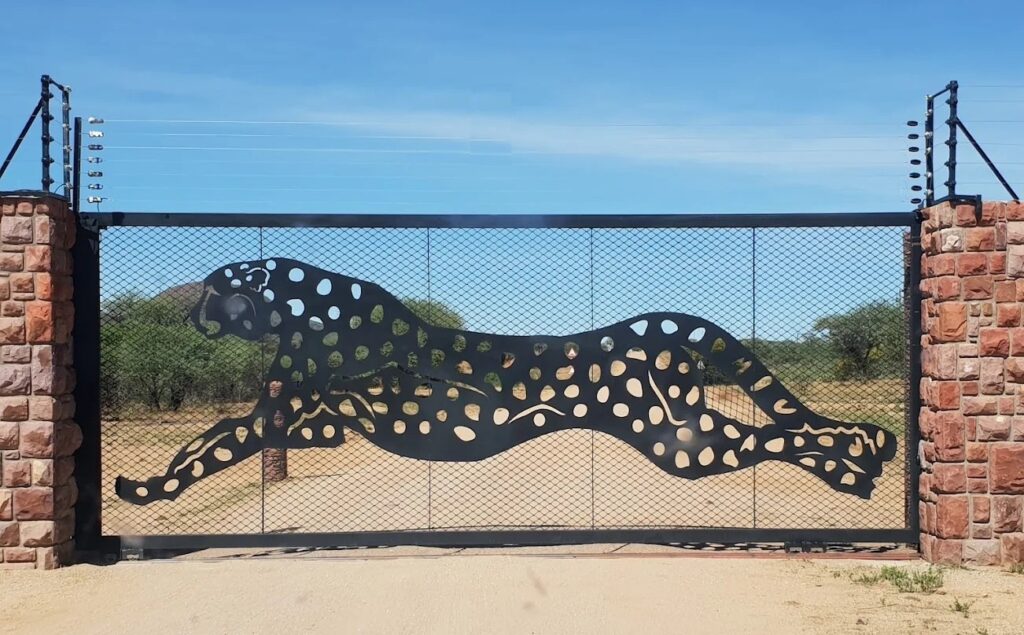
After passing through the gate, you will enter the 220 sq km (85 sq mi) private nature reserve. In the 1970s, this was a cattle farm. In the 1990s, they removed the cattle, fenced the farm, and converted it into a nature reserve to protect the local wildlife.
The gate opens by pressing a button on a post. After passing the gate, you have about another 12 km to the lodge. Drive slowly and watch for wildlife along this section. You might see baboons, ostrich, antelope or other wildlife.
The Lodge
The huge reception area and restaurant was once the cattle barn.
Tours
Okonjima Nature Reserve offers several wildlife viewing tours, including:
- Leopard tracking
- Pangolin tracking
- Rhino tracking
- Birding
- and a few other tours
Accommodation
It is important to note that the wildlife viewing tours are only available to people who have booked accommodation for at least one night. You cannot go on any of these tours if you have not booked accommodation. Okonjima is very popular, and you will probably need to book months in advance.
Ask for a “View Room”. These spacious one-room cabins feature a large window that occupies most of the wall facing the reserve. The beds face the window. We saw warhogs, jackals and other wildlife right from our bed. It also has an outdoor patio and a covered parking area. There is a lot of space and trees between cabins, so it is like you are alone.(There are both cheaper and luxury accommodations available, but I think the View Rooms are the best for the money).
Leopard Tracking
If you leave Windhoek after breakfast, you should get to the lodge by noon. This gives you plenty of time to settle into your accommodation, have something to eat, and get a little rest before the tour, which begins at approximately 3 p.m. I skipped the rest and spent a couple of hours photographing wildlife around the cabin and the reception area. There is a small waterhole located just outside the main building that attracts a variety of wildlife. I got some nice photos of jackals, warthogs and birds.
Okonjima Nature Reserve has several leopards that have been collared, allowing guides to track their whereabouts. Still, it is not guaranteed that you will see a leopard. This is not a zoo or a game farm. They are not captive animals. They go where they please. The leopards might be in an inaccessible area or too far away to see and return before dinner. Having said that, your chances of seeing a leopard on this tour are not 100% but they are excellent.
We drove around for a couple of hours looking for the leopards. The driver stopped periodically and listened for the signal from his tracking device. I was beginning to think that we might not see one. But just before giving up, the guide found two of them.
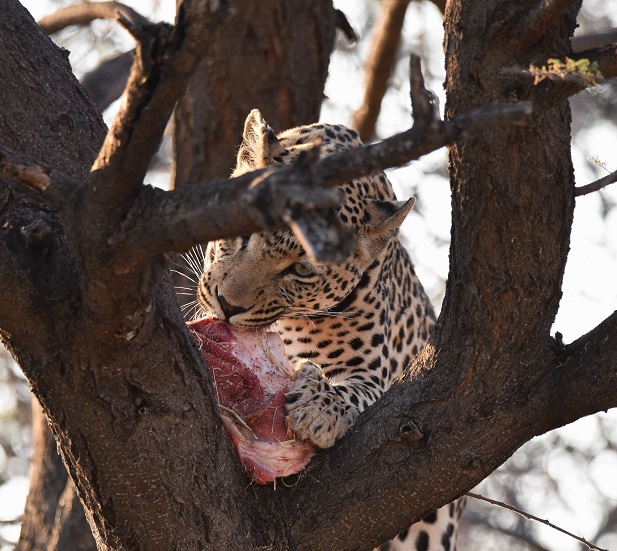
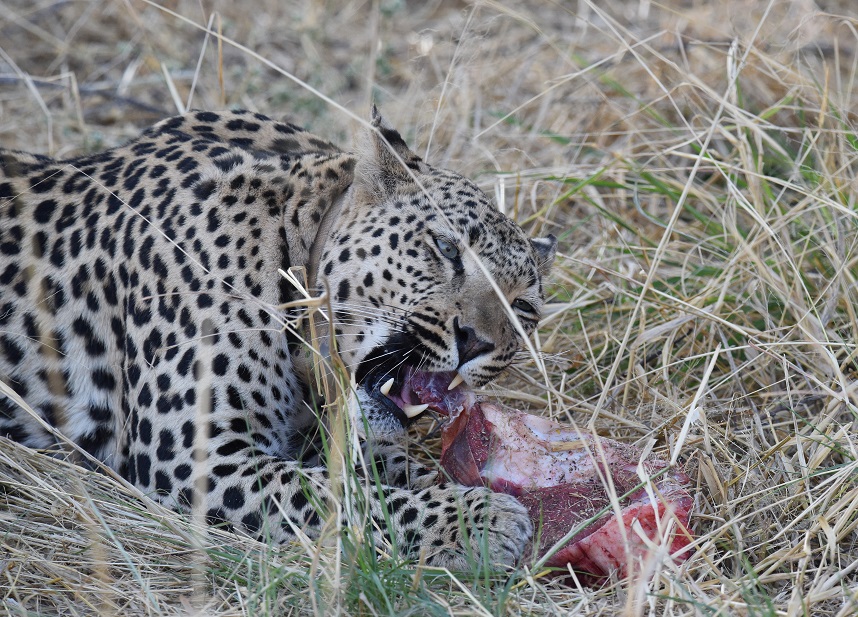
The first one was a small leopard eating a huge chunk of meat. The leopards are accustomed to the safari vehicles, but this one was a bit nervous and, to protect his meal, he went up into a nearby tree.
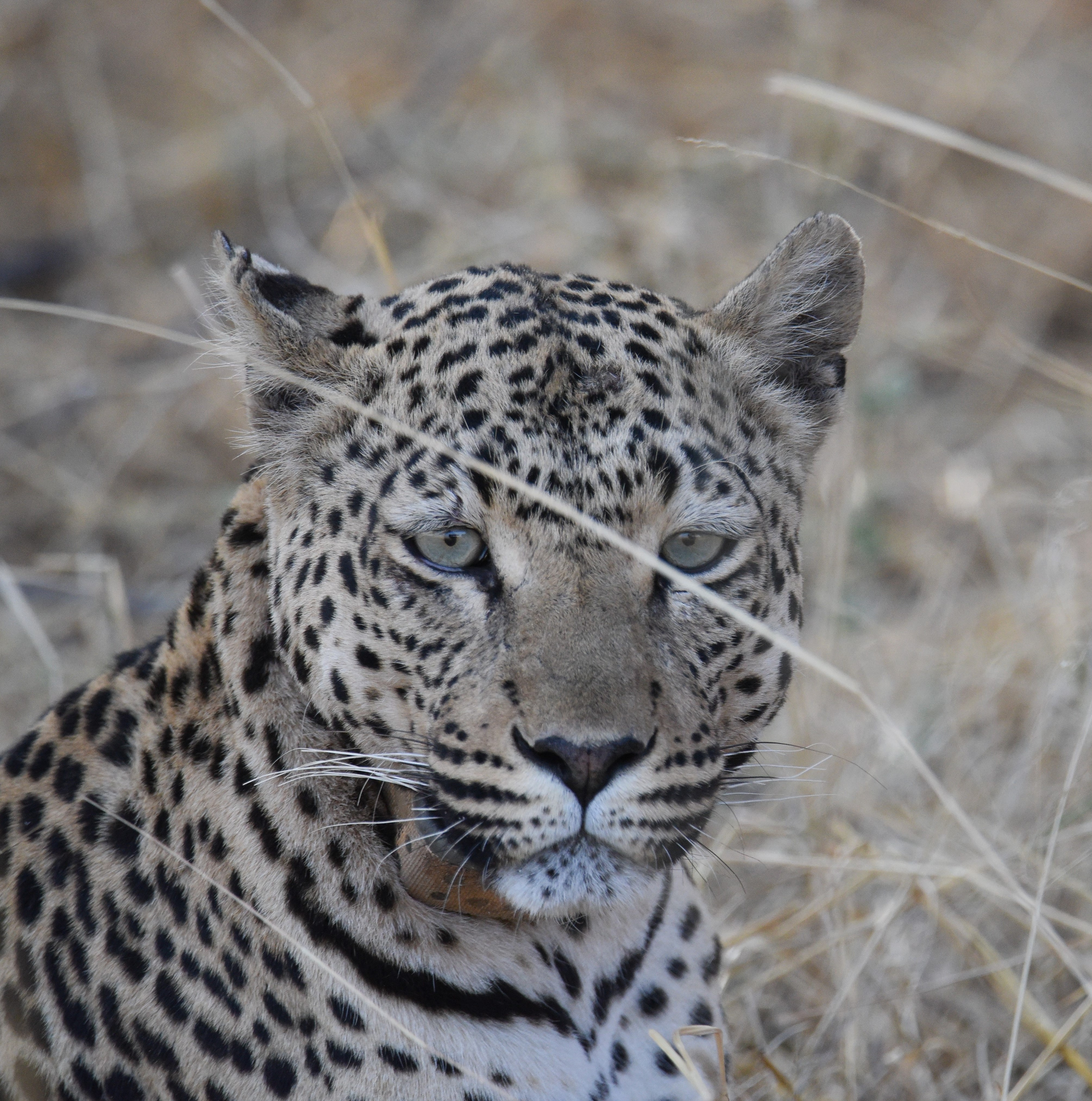
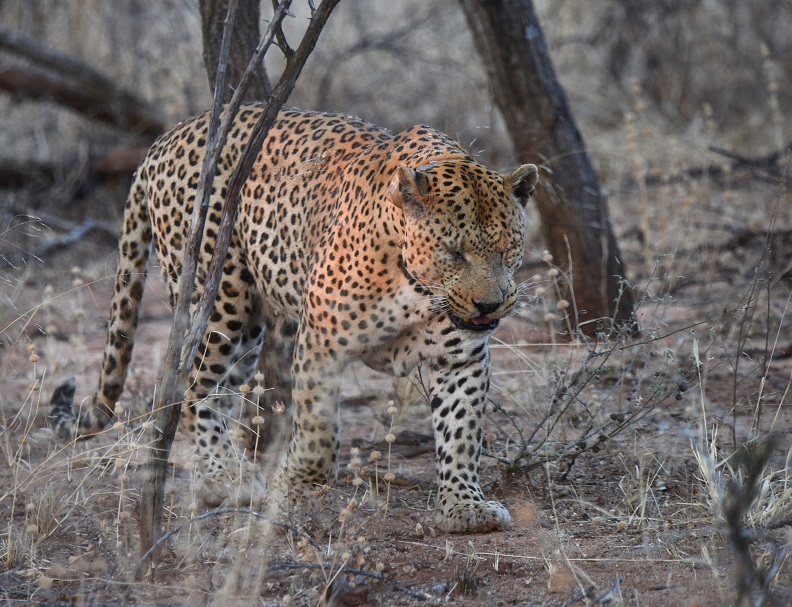
A short while later, we saw a second leopard. This one was huge. It walked around in the bushes for a few minutes, and then he came out and walked toward our vehicle. He walked directly toward the place where I was sitting. He stopped about three meters away. We looked into each other’s faces for about ten seconds, and then he turned and walked away.
I will never forget those few seconds of being face-to-face wth this giant cat. I often wonder what he was thinking at the moment. Safari vehicles in Africa have a body and a roof but no sides. There is nothing to stop a leopard or lion from jumping in and attacking people, yet they refrain from doing so. I am sure that if I had been on foot, the leopard would have attacked me. The theory is that they don’t see a truck full of humans as individuals. It is thought they see some kind of mult-headed, harmless monster.
So, after my Puma encounter in Chile, this was my second thrilling close encounter with a predotor cat.
Safari Vehicles
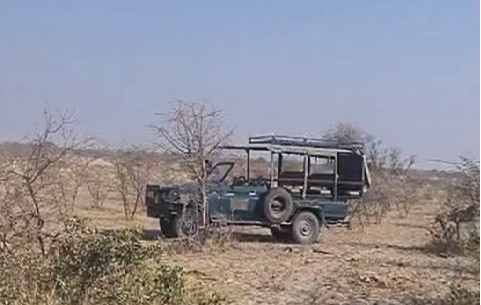
While lions, tigers and leopards will kill humans if given the opportunity, they do not attack people in open-sided safari vehicles. Conversely, cheetahs will jump up on safari vehicles but not to attack anyone. No person has ever been killed by a cheetah. There are many photos on the internet of cheetahs climbing on safari vehicles, often in very close proximity to the tourists. They frequently climb up on the roof of the vehicle to get a better look at the area around them, perhaps to find prey.
Conclusion
By the time we got back to the lodge, it was dark. We were treated to an excellent, romantic, candlelight dinner at the outdoor restaurant by the waterhole.
Our stop at Okonjima Nature Reserve was one of the highlights of our African tour. We stayed one night. I was unaware of how great the place is. In hindsight, if I were to make another trip to Namibia, I would book three nights at this great place and take the Pandolin and Rhinoceros tours in addition to the Leopard Tracking tour.
Links
You may also be interested in reading this article about how we prepared for our trip to Africa. We did not go on an organised tour. We rented a vehicle and toured four countries across southern Africa independently.